
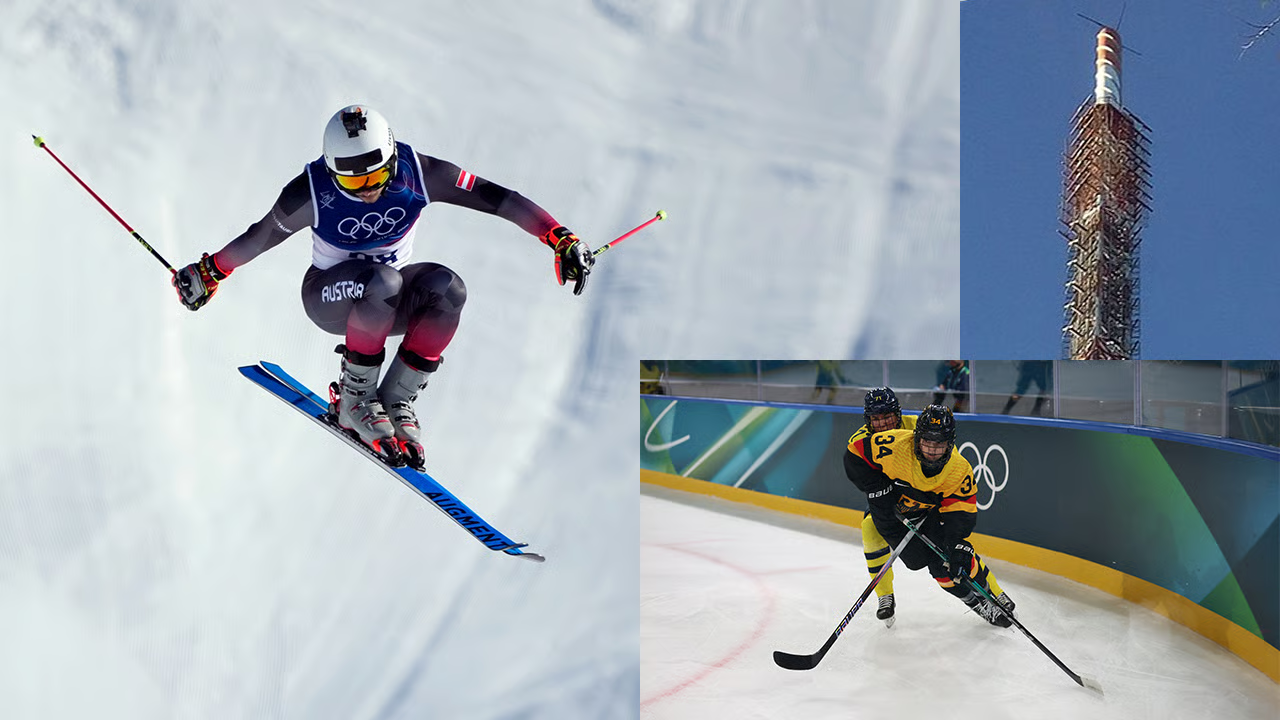
Building on successful demonstrations during the Paris Olympics 2024, Italian public service broadcaster Rai and the European Broadcasting Union (EBU) are conducting new 5G Broadcast trials during the Milano Cortina 2026 Olympic Winter Games.
Continental European countries looking at how technology performs during major events
Pre-commercial trials are underway at the Winter Olympics to explore how 5G Broadcast can leverage resilient broadcast tower infrastructure to expand live, free-to-air delivery to smartphones and other end-devices, especially for demanding use-cases such as live coverage of major sports events and the delivery of essential services to mobile phones in emergencies.
Unlike conventional mobile streaming, 5G Broadcast is designed to deliver the same content to unlimited numbers of users without congesting mobile networks or consuming user data allowances.
How does it work?
It combines the efficiency of traditional digital terrestrial television (DTT) with 5G technology to achieve a high level of geographic coverage and a great number of addressable devices.
5G Broadcast TV utilises the broadcast towers used for terrestrial TV. Unlike terrestrial TV signals, the 5G Broadcast signal can reach multiple devices, including smartphones and any end-user device that is equipped with 5G support – potentially actual TVs in the future.
The first 5G Broadcast-compatible devices are smartphones, specifically the Motorola Razr 5 and Moto Edge Plus, with more Android devices expected to gain support from 2028.
Austria, France, Germany and the Netherlands are among other countries experimenting with the new technology. There’s also been interest in 5G Broadcast from the United States.
What’s being tested?
The Milano Cortina trials continue Rai pre-commercial, large-scale trials that have been running since early 2025. During this winter’s Olympic Games, the partners will evaluate reception, service robustness and user experience in the metropolitan areas of Rome and Turin and assess how broadcasters could integrate 5G Broadcast into hybrid distribution strategies.
Gino Alberico, Director of the Rai-Centre for Research and Innovation commented:
“Major events like the Olympics are the ultimate stress-test for new distribution technologies. With 5G Broadcast we can bring live content directly to compatible devices with broadcast efficiency – opening the door to better coverage, improved resilience, and new ways to reach audiences on the move.”
Antonio Arcidiacono, CTO at the EBU, added:
“Paris 2024 showed that 5G Broadcast can move beyond the lab, with demonstrations on hundreds of consumer devices. Milano Cortina 2026 is another important step: validating performance in a real operative environment, helping align the ecosystem, from broadcasters and network operators to chipset and handset manufacturers, around a shared, interoperable standard that can deliver live content day after day and simultaneously increase resilience in case of emergencies.”
The EBU holds Olympic media rights in Europe, together with Warner Bros. Discovery, through 2032, supporting broad free-to-air coverage for television and digital platform audiences across the European continent.
Image: EBU