
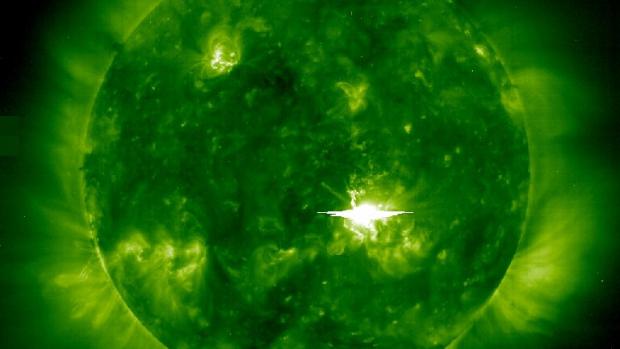
Broadcasters and telecoms operators worldwide have been told to expect issues as an extreme solar storm continues to hit the planet this weekend.
- USA’s National Oceanic and Atmospheric Administration (NOAA) says there have already been instances of disruption to GPS and high frequency communications.
- The G5-level storm caused the Northern Lights to be widely visible across the UK and Ireland on Friday night.
The strongest solar storm in over 20 years is keeping broadcast and telecoms infrastructure operators on guard.
Extreme conditions, following strong solar flares from a cluster of sunspots have resulted in the Earth being hit by solar winds of around 800 km a second, or 2.88 million km per hour (1.78 million miles per hour).
According to the US National Oceanic and Atmospheric Administration (NOAA), radio frequency disruption has been occurring in high frequency ranges.
Radio disruption during daytime hours
While the Northern Lights became visible across many areas of the UK and Ireland on Friday night, during daytime hours as the British Isles faced the sun, they were at the epicentre of heightened radio disruption.
Users of high frequency radio signals, notably ham radio operators and commercial airlines were warned of disruption. A shortwave radio blackout was reported in parts of Asia, eastern Europe and eastern Africa.
Nowadays, most regular radio services operate on frequencies less affected by solar storms. And even broadcasters like the BBC World Service have become far less reliant on shortwave to reach audiences.

On Saturday, NOAA said it had received reports of power grid irregularities and degradation to GPS. Space X warned users that its Starlink broadband service might be affected.
Earlier, the organisation also warned of possible impacts on VHF and UHF communications – the frequency bands used in the UK and Ireland for FM, DAB, Freeview/Saorview, maritime and emergency services radio.
So far, there have been no reports of major issues relating to the solar storms. However, some parts of the British Isles may experience weather-related degradation to TV and radio reception. High pressure weather related reception problems are common during the summer months. It tends to manifest itself more often in coastal areas.
Solar storm part of regular solar cycle
The storm reached the maximum possible rating of G5 on NOAA’s scale of solar storms. It coincides with the peak of the sun’s normal 11-year solar cycle. A cluster of sunspots is expected to send further flares blasting the Earth with further electromagnetic radiation, with warnings for the remainder of the weekend.
At night, the interaction of the solar particles with the atmosphere manifests itself through the Northern Lights (Southern Lights near the South Pole). During normal solar conditions, these are confined to polar regions, extending beyond these areas only during major storms.
The current storm hasn’t yet reached the levels of the famous Solar Storm of 1859, when the Northern Lights were seen as far south of Cuba and Honolulu. That storm wreaked havoc with telegraph communications, causing surges and disabling telegraph stations.
Heightened solar activity, although not necessarily on the level experienced this weekend, is expected until mid-2025.
How do solar flares affect satellites?
As geomagnetic storms from the sun hit the earth’s atmosphere, there’s an increase in electrons within the magnetosphere. This can penetrate the shielding and damage the electronics inside satellites.
During the storms, satellites may not be able to communicate with earth stations. Changes to the ionosphere in a storm affects how radio waves interact and pass through it. GPS users may find their devices struggles to lock on to a signal or doesn’t show their exact location.
Solar flares and radiation from the sun also has the potential to affect satellite TV reception. So far, there’s been no reports of any issues affecting Sky and Freesat viewers in the UK or Ireland.
By: Marc Thornham | Image: NOAA